




It's Kili Time - AGAIN!
11 years ago
Why hello there. It's been a while, hasn't it? I feel that I owe you all an apology, but instead of that, I'll jump right into whats been going on in my life the past month (and flesh out the title of this post a bit).
Springtime in Barcelona has been fab. The weather's turned from intermittently sunny and warm/overcast and cold to a steady partly cloudy and 75 degrees, to the extent that I don't even need to look at the weather forecast to know what I'll need to wear. I've been taking advantage of the weather to do the things I've neglected to do up until- tan at the beach, play ping pong on the outdoor tables scattered around the city, lunch on sidewalk cafes. The company on these activities hasn't been bad, either. I've made a handful of new friends, including David, an American who's here on a research fellowship to study linguistic nationalist movements, but he seems to spend most of his time wandering the city and tempting me with new adventures. My super-cool friend Elena also stopped by for a week on her way back from a semester spend doing research in rural Senegal. I can't even begin to imagine the culture shock that she must have experience on her return to civilization, but part of what makes her super-cool is her cheery disposition and positive attitude, and it was great to catch up over tapas, the riots on Las Ramblas after Barça won the European Club Soccer Championships, and day trips to the countryside.
On the job front, I'm happy to report that I no longer have one. I gave my boss three weeks notice in mid-May, and I was let go at the end of that month after he found my replacement. I expected that I'd be a little more upset about this than I actually was, but at the same time, I haven't found ti that liberating, either. I suppose that just living in Barcelona and working 20 hours a week is liberating enough; additionally, with my clock ticking down on my time in Europe (just three more weeks left), it was a matter of time before my employment had to come to an end.
Now that I am uncommitted and independent, I'm backpacking around Europe for the first time since I've moved over here. I spent three days in Oxford, England, visiting my close friend Jason, who's there doing a Ph.D. in politics. I was taken aback at how much I liked Oxford- it's the prototypical university town, a mix of Yale and Hogwarts, and about the only place where college students can live in a real castle. Jason showed me a fantatic time, taking us punting (think Venetian gondoliers, but without the uniforms or class), allowing me to peek my heads into all the Gothic colleges around town, and introducing me to such Oxfordian pursuits as formal college dinners and pints at The Truf (the pub where Bill Clinton didn't inhale).
And after a 12 hour trip, I now find myself in Istanbul, looking out at sunset onto Asia across the Bosphorus, listening to the evening call to prayer being sung from the minarets of the Blue Mosque. I can't really give too detailed of a description, since I haven't wandered far from my hostel yet, but so far, the striking things about the city have been its minarets, flags, and water. Flying into the city and driving into it, you can see hundreds of slender and elegant minarets piercing the sky above the city, and the mosques that they're attached to are made of overlapping, seemingly floating domes. Turkish flags are everywhere- this country is as nationalist as it's made out to be- and from the roof of my hostel I can make out four GIANT one about 5 miles away. And water- it's hard to say strongly enough just how much the Bosphorus shapes the city, both in its layout, and in its character. Orhan Pamuk, in his memoirs of growing up here, writes that the Bosphorus is the oul of the city, and from my 6 hours here it's hard to disporve that claim. Once I walk around tomorrow, though, I'll be sure to check it out in more depth.
I'm in a great state of mind now, refreshed by my time in England (being surrounded by English was such a treat), and ready to dive into another culture. If you have any tips on what I can do here, don't hesitate to let me know.
Apologies for not posting more frequent and timely updates. I would make the excuse that my life here is uneventful, normal, and boring, but the truth of the matter is that I've just been too lazy and unmotivated to post. Let's fix that...
Two weekends ago, I went with my Sardinia companion and general travel buddy Grant to Malta. A little geographical background- Malta is a country just south of Sicily made up of three islands, but whose total land area is only about 300 square miles (about the size of Queens). It's a little difficult to conceptualize just how small a 300 square mile country is without seeing it for yourself, but as a rough idea, from Malta's highest point, you can see over half of the country. On a map, the lone airport's runway seems to run half the length of the main island. And traveling from one end of the country to the other by a public bus and ferry takes about 2 hours. On bad roads. With traffic. Get the picture?
The inspiration for this trip was Grant's desire to visit North Africa or someplace near it to practice his Arabic, but the motivation for the trip came from the €10 roundtrip tickets we found on Ryanair's website. (How they make money selling tickets that cheap is beyond me, but I only wish they could do that in the States, too.) Between the time when we bought the tickets and actually got on the plane, I did some reading on Malta, which gave me the impression that Malta was like England, but with more sun and religion- it's an Anglophone country, is famous for its beaches and nightlife, and is incredibly Catholic. Reading these description, I convinced myself that going to Malta would be a good preview of what I would be like to return home and deal with the culture shock. People speaking English all the time, food that doesn't all contain ham, American meal schedules- I was psyched about visiting a US-lite.
But oh boy, was I ever wrong. Malta is by far the most unique, eccentric place that I've ever visited, and my expectations could not have been more wrong. Some general impressions:
 The fireworks show, from our hotel room window.
A lazy Saturday morning found me browsing the internet absentmindedly. Stumbling on this site, I saw a postcard confessional which had me kicking myself for not having thought of it earlier:
Granted, the vocabulary that my students learn does have a decidedly West-coast slant. Particular teaching highlights include "hella" and "hecka" as amplifiers, "chillin'" as a synonym for "hanging out", and "royally POed" to describe intense frustration. But I wish that I had been fiendish enough to intentionally mess with my students' vocabulary. I mean, how funny would it be to hear Spaniards talk about how "whack" a situation is?
So I'm sitting in the living room, reading some political blogs after having finished dinner. The radio's on in the background: it's tuned to the Champion's League soccer semifinal match between Barça and Chelsea, and Barça's losing 1-0. The result of this game will decide who will go on to the finals and have a chance to win the European soccer club title. Due to the vagaries of the competition rules, all Barça has to do to advance is tie; Chelsea needs to win. It's not too much of a stretch to say that nearly the entire city is tuned in to the match; there's nothing more dear to Barcelonans than their blaugrana.
Anyways, I'm sitting at my computer, when from out of nowhere and simultaneously, my flatmate starts screaming, car horns go off, and a cheer from what sounds like thousands of people erupts from outside. Barça had just scored the tying goal in the FINAL minute, and when the match was whistled over shortly thereafter, the pandemonium only intensified. Right now, just a minute after Barça officially moved onto the finals, I can still hear annoucers jabbering away excitedly on the radio, cheering from outside, fireworks, and car horns. If I didn't know the origin of these noises, I would fear for my safety.
As my stunned flatmate said, "Que fort." Que fort, indeed. I imagine I'll be hearing about this match for days, and I'll definitely be hearing its aftermath all tonight. I'm just glad that I don't have early classes tomorrow...
I normally don't post news articles on this blog, but something caught my eye today while I was browsing the New York Times:
Spain's top investigative magistrate opened an investigation into the Bush administration Wednesday over alleged torture of terror suspects at Guantanamo Bay.There's a lot that I can (and probably should, but won't now) write about this, like whether the torture memos were justifiable, or whether Obama's decision to release them was wise. But since this blog focuses on Spain, I'll hold off on a US-centric angle and write instead from an across-the-pond perspective.Judge Baltasar Garzon said documents declassified by the new U.S. government suggest the practice was systematic.
Garzon said he was acting under Spain's observance of the principle of universal justice, which allows crimes allegedly committed in other countries to be prosecuted in Spain. [...]
In a 10-page writ, he said documents on Bush-era treatment of prisoners, recently declassified by the Obama administration, "reveal what had been just an intuition: an authorized and systematic plan of torture and mistreatment of person denied freedom without any charge whatsoever and without the rights enjoyed by any detainee."
It's a bit embarrassing that even after seven months here, I haven't written about Catalunya's number one obsession- el futbol. But over the past week, there have been two major matches which have given me a good look at the depth of this obsession, and I'm starting to grasp exactly why soccer is such a powerful force in this little corner of the world.
Bigger than ham, mushrooms, and pooping peasants, soccer is what Catalan life revolves around, and the most important team in its universe is FC Barcelona, or Barça for short. Barça plays in the top Spanish league, and this year it's sat atop the rankings since the season began in the fall. From what my flatmates tell me, this year has been an exceptional year- Barça routinely destroys its opponents, no small feat in La Liga, which is widely considered to be one of the top leagues in the world. Even to the untrained eye, you can't help but be impressed by the way that Barça plays. Its passes are crisp; the ball moves across the field with ease; the players look like they're toying with their opponents; and goals can only be described as spectacular. As an inexperienced soccer fan, there's no better way to become passionate for the game. Still, I wonder if I'm just setting myself up for disappointment. It's like learning to appreciate classical music by listening to Mozart play his own concertos: there's no better education, but afterwards nothing else can compare.
(As an aside, I'm surprised that soccer hasn't caught on in the US. It's not difficult to draw parallels between it and other American sports. Like baseball, it's a relatively static game punctuated by rapid spurts of action, and points/goals are few and far between. Like football, it's a physical sport with a rabid, involved fan base. And like basketball, there is consistent movement, with little stoppages of play. [Note: last comparison not valid in the 4th quarter of most NBA games.] )
Barça's success this year is not just of interest to those who are rabid soccer fans. Instead, the entire city is following the team's exploits, reading about the previous game on the Metro, talking about it at cafés, and watching every game on television. Tonight's game was demonstrative: a semifinals match in the Champoins Leage (a competition of the best club teams in Europe), and the city streets were deserted, stores closed early, and bars were packed with people watching the hometown team take on Chelsea, a top British club. Even the kids that I teach follow the team. The first thing my 8 year old asked me today was if I was watching the game. (Another student, a 6 year-old, can name Barça's entire roster.) If there is such a thing as a non-soccer fan in Catalunya, I'd love to see it.
The key to understanding Barça's appeal to Catalunyans can be found in its slogan, "Més que un Club." While many teams claim to represent more than just its owners desire to make money by overcharging on tickets and consessions, to people here, Barça is more than just a club. It's a symbol of Catalan sovereignty and pride, dating back to the Franco years when Catalan culture was severly repressed and nearly stamped out. Deprived of the ability to openly speak their language and celebrate their traditions, Catalans of all types gravitated towards the Barça football club to project their nationalist feelings and protest against the Dictadura. That's why today, the most heated rivalry in all of Spanish soccer is between Catalan Barça and the formerly Francoist RC Madrid, which was heavily supported (and even today still is) by the military and conservative types. When these teams play, life in Barcelona comes to a stand-still; the glow of TVs can be seen out of nearly every apartment window, and tensions run so high that normal conversation is impossible in the days leading up to a game.
If it's possible to read more into soccer than what's presented on the field, then the Barça football club reflects not only the Catalan identity as we see it today, but also it's development and self-definition over the past 75 years. It's not only a club, but a point of difference between Catalans and other Spaniards, who might never have had to experience the suffocating repression and subsequent rebirth of their culture. But enough about this; despite these deeper meanings, to Barça fans, only one thing matters: the final score of the last match.
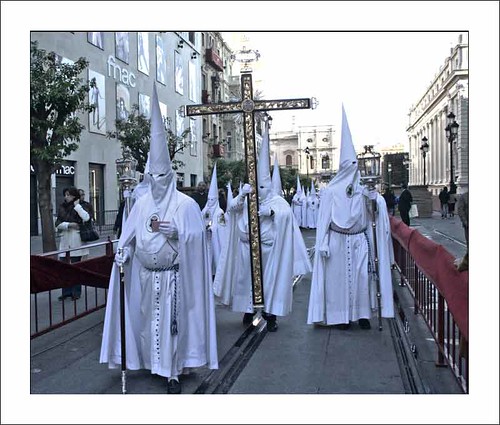
No, this post does not refer to confusion regarding racism or the KKK (though these costumes found in Holy Week processions could lead to that uncertainty). But what does have me wondering if I have been transported to the South is some bizarre weather that's struck Barcelona this past week- namely, thunderstorms and hail.
In normal years, Barcelona doesn't get much in the way of rain. The large amount of rain that the city's received this year has been an anomaly, surprising the locals, though it's pretty normal by San Francisco standards. But things have gotten weird since I've been back from Sardinia. Last Friday night, there was a huge thunderstorm that hit the city for a few hours. For someone who hasn't heard thunder for almost a year, it was a shock for me, but oddly enough also made me feel less homesick, like I was visiting my relatives in Louisiana and not 5,000 miles away. Anyways, this storms caused some massive beach erosion, lots of fallen trees, and the papers even dropped a few mentions of the "G-W" phrase as a possible cause (if you're having difficulty, think Al Gore, not George W.).
This was followed up on Thursday by something even weirder: a hail-storm. In a span of five minutes, the day went from sunny and warm, to cool and end-of-days-ish. Pellet-sized bits of hail fell for about 5 minutes, completely interrupting a class I was holding, though no one really cared. And just as soon as it started, the hail stopped, the sun came out, and everyone acted as if nothing had happened (which might have been even more surprising than the weather in the first place).
At the least, the wild weather has made me feel a little more at home, and has made my days a little more unpredictable. It's also giving me a great excuse to plan some weather-themed lessons, which for an idea-starved teacher is the greatest gift of all. So it's time for my students to put their wellies on and go outside- though sadly there's no Southern BBQ as a reward for getting through class.
Though one might think otherwise from reading my blog, my life's been more than working, produce shopping, and enjoying the mostly sunny springtime weather (though I would be completely happy if it were just the last one). Two weeks ago, taking advantage of a week off of work, I went with my friend Grant to Sardinia.
But one thing about Sardinia that is especially appealing to Catalans is that it contains the only place outside of Spain where Catalan is spoken. The official language of the town of Alghero (or l'Alguer) is Catalan, and it was definitely a surprise to be able to read street signs and talk to the taxi driver (though he also spoke fluent English, which we quickly reverted to). Alghero's Catalan status seems to be a big source of pride to Barcelonans, almost to the point of them fetishizing it- in the travel bookstore I found a surprisingly large number of travel guides to Alghero, which became even more surprising once we got there and found a definite dearth of things to do. So let's get onto that...
We flew into Alghero on Friday night and went straight to our bed & breakfast, where we would spend the next four nights. We had chosen the Mamajuana not just because its name sounded illicit, but also because the guidebook had given it rave reviews, especially singling out its breakfast, "served at a cafe across the street," for special mention. Imagine our surprise the next morning when we discovered that not only was there no cafe across the street, but that the breakfast was actually served from a VENDING MACHINE located under the B&B's stairs. While a breakfast of Fanta and Kinderbueno candy bar made us feel a little better, we did feel let down by the guidebook (Rough Guide, you will rue the day you were printed), and set out to explore the city on partially empty stomachs.
Disappointment was the theme of our trip for the next three days. The day trip I had planned to visit Neptune's Grotto, "without a doubt the post popular excursion" (sic) from Alghero, was scuttled when we discovered that it was closed for "renovations," necesitated by a freak storm three months earlier. (How a natural cave can be renovated is beyond me, but I digress.) Grant's ATM and credit cards refused to work, which turned me into a sugardaddy, and turned our trip into an exercise in thriftiness. A dinner became a let-down when I ordered a pepperoni and melanzane pizza, expecting an exotic meat and melon delight, but instead received a peppers and eggplant (apparently the correct translation of the menu). And the 5 movies I had downloaded onto my computer before leaving were rendered useless when I forgot my recharging cable at home. Instead of the movies, our nightly entertainment was tag-team solitare and six episodes of Project Runway Grant magically had on his iPod.
Things changed for the better at the midpoint of our trip. After a 4-hour search involving two long bus trips and much groveling, we managed to rent a car that promised to liberate us from the mental captivity we were feeling. But before we could drive freely on the Italian roads, we had one more difficulty to overcome: the manual transmission. Undaunted, our intrepid adventurers tackled the challenge head-on. Armed with nothing more than guile, confidence, and printed instructions from eHow.com, Grant and I conquered our vehicle with only a minor mental breakdown to show for it. (N.B.- Avoid driving in medieval Italian cities at all costs. This is from experience.)
The last three days of the trip were a complete change from the first three days. We explored the northern coast of the island, which was blissfully empty of tourists and the high prices that they bring. We saw prehistoric ruins, walked on amazing beaches, ate meals that didn't come out of a vending machine, and stayed in hotels with ocean views and cheap prices to boot. For an exampe, the photo on the right was taken from our €60 a night hotel room, overlooking the Mediterranean, and with views of Castelsardo, a hilltop fortress dating from the 14th century.
But my far the coolest, and most photogenic part of the trip, was out day visiting Capo Testa, the northern-most part of the island, and the site of some of its most dramatic scenery. Blue-blue water, light-sand beaches, and rocks strewn all around. In Grant's words, "It looks like where Gaudi practiced his designs." Anything else that I can write can't do it justice, so I'll leave you all with some pictures to get a sense of the scene.
After spending four hours playing on the rocks, everything else was just gravy. We had a celebratory bottle of wine (or three) at dinner, retired to our room which overlooked the beach and had views of Corsica, and woke up the next day to make it back to Alghero in time for our return flight.
All in all, it was a fantastic trip. One not-so-good effect of great trips, however, is a bit of a travel hangover, which has hit me hard and made it next to impossible to get back into the swing of things at work. Oh well, worse things have happened (like, say, breakfast out of a vending machine). Just 2 more weeks until our next adventure (MALTA!), and then possibly a trip with Jason to Istanbul in June. Updates to come!
As much as I would like to think that English instruction is so vital that it's resistant to the economic crisis, so far it's turning out to be just as vulnerable as Coke (a-Cola) parties on 30 Rock. Last month, I lost 3 hours due to budget cutbacks at companies where I taught; today, I just found out that I'm losing another 2.5 hours a week for the same reason. This makes me sad for a few reasons, least of which financial; Fernando was one of my favorite students, class was fun and easy to prepare, and now I have another chuck of my week with nothing to do. Free time is deceiving: the more of it you get, the less idea you have of what to do with it.
It's not hard to see all the ways that Spain is suffering because of the economic crisis, especially from my foreign, English teacher perspective. Companies are cutting back on expenses, and those that haven't canceled their English classes have cut back on other costs, like flower purchases, bottled water, and according to some of my students, writing implements (bring your pen to work day!). The amount of for rent signs up in empty store windows is staggering- in fact, the car dealership that used to be on the ground floor of my building moved out a few months ago, and I doubt that anyone will move into the space while I'm still in Spain. And the gym that I go to is packed with middle-aged adults during the afternoon, when one would imagine that most of them would be at the office.
From what I hear from family and friends, the scene at home is similar, which makes me all the more hesitant to go back. It's a bit ironic that it has been easier for me to find work living illegally in Spain than it has been back home in the US. But if my recent lost classes are any trend (and I suspect that they are), I might be equally unemployable on both sides of the Atlantic. And if that's the case, what difference does it make where I live?
My receipt from a recent trip to the produce market:
2 packs of lettuce
1 bunch of asparagus
2 nectarines
2 big apples
2 lbs of oranges
4 bananas
4 yellow plums
Total: €5.89
It's not just produce that's this cheap. At the grocery store, I can spend around €30 for enough food to last me the entire week. And at the neighborhood farmer's market, I can supply myself for even cheaper. It's been a while since I've gone grocery shopping in the US, but from what I remember, it would cost me almost double what I spend here to eat comparably back at home.
Despite being cheap, the food here, especially the produce, is GOOD. Like, perfectly ripe, bright colors, and keeps for a good amount of time. I guess that that's a result of the food being grown closer to the city- Barcelona is surrounded by farmland, and most fruits and veggies come from the province. A short supply chain means tastier, cheaper food. Makes you wonder why this hasn't caught on in the US, if just for economical reasons.
Another benefit: a consistently healthier diet. When food is this cheap, why would you even want to eat junk food?